Introduction
When a man sets out to build a house, he does not begin by pouring concrete or raising walls. The first thing he must do is buy the land. Ownership must be settled before anything else can take place. Until the land is purchased, no foundation can be laid and no house can be built. In the same way, before salvation could ever be applied to mankind, the price of redemption had to be paid.
The four Gospels—Matthew, Mark, Luke, and John—record how Almighty God stepped into His creation to do just that. Through His birth, ministry, death, burial, and resurrection, Jesus Christ purchased what was lost. “For ye are bought with a price.” The Gospels show us the cost of redemption being fully paid.
After land is purchased, preparation begins. The ground must be cleared, leveled, and made ready. Stones are removed, debris is cleared away, and the soil is examined. This stage is very important and essential. Without preparation, even the best foundation will fail. In the same way, the Lord prepares the heart. In John chapter 3, Jesus speaks with Nicodemus about the necessity of being born again. This was not about outward religion, but inward readiness. Before anything could be built, the heart had to be prepared. This ingredient in the foundation is called Repentance.
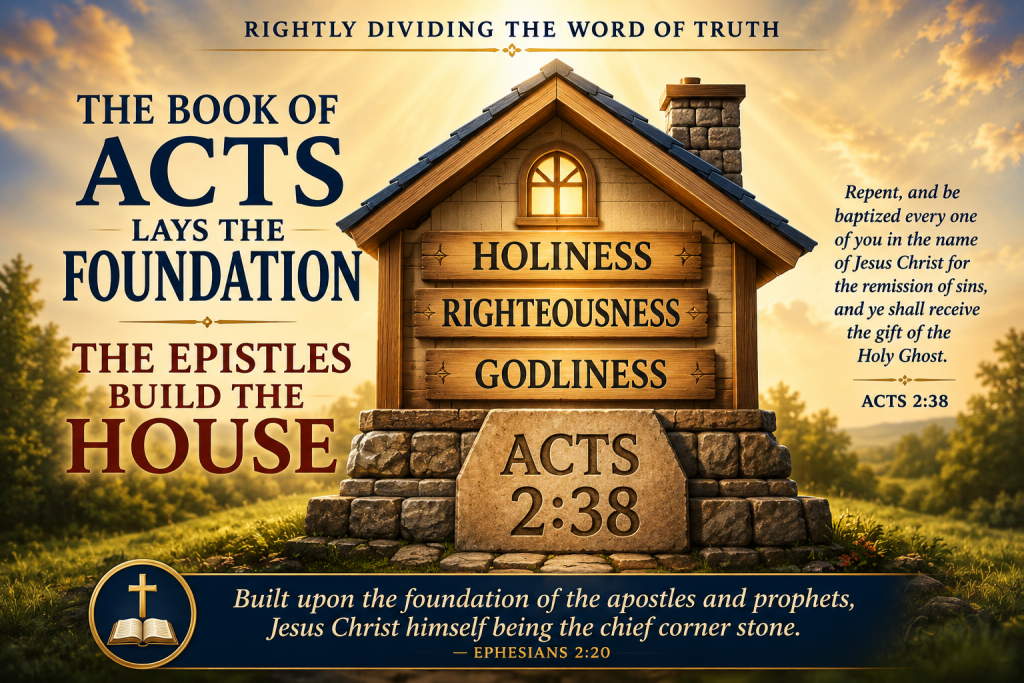
Only after the land is bought and the ground prepared does the foundation come. This is where permanence begins. The foundation determines the stability of everything that follows. The Book of Acts shows us where that foundation was laid. On the Day of Pentecost, when the people asked what they must do (Acts 2:37), Peter declared repentance, baptism in the name of Jesus Christ for the remission of sins, and the receiving of the Holy Ghost (Acts 2:38). This was not merely a theory of salvation, but obedience to the Gospel. This is the laying of the foundation.
Once the foundation is laid, the house can be built. Walls go up, rooms take shape, and the structure becomes a place to live. Rooms of holiness, righteousness, godliness, faithfulness, and spiritual maturity begin to take form.
This is the role of the Epistles. They do not purchase the land, nor do they lay the foundation again. Those things have already taken place . The Epistles were written to believers who had already obeyed (Acts 2:38). They instruct, correct, reprove, and guide the Church in how to live and build upon the foundation laid in the Book of Acts.
When the order is followed, everything fits together as God intended. But when Scripture is taken out of order or read without context, confusion follows. A house without a foundation cannot stand, and a foundation without purchased land has no rightful place. When God’s Word is rightly divided, however, the beauty and clarity of salvation come into full view.
The Gospels: The Land Is Purchased
Before a house can be built, the land must first be purchased. The Gospels reveal how God Himself came into the world in the person of Jesus Christ to purchase redemption for fallen mankind.
His miraculous birth, sinless life, sacrificial death, burial, and victorious resurrection secured what no man could ever obtain on his own. The Gospels are the record of redemption being purchased. The price was paid in full at Calvary.
Without the purchase of redemption, there could be no salvation. Before the foundation could be laid, the land had to be bought.
Preparing the Ground
Once land is purchased, it must be prepared. Trees are removed, rocks are cleared away, and the ground is made ready to receive the foundation. This is how repentance looks.
Likewise, God prepares the heart of man.
Jesus told Nicodemus:
“Except a man be born again, he cannot see the kingdom of God.” (John 3:3)
Salvation is not merely accepting a religious belief. It begins with a heart that is willing to obey God. Repentance softens the soil of the heart and prepares it for what is to come.
A foundation cannot be poured upon ground that has not been prepared.
The Book of Acts: The Foundation Is Laid
Every house depends upon its foundation. If the foundation is weak, the entire structure is at risk.
The Book of Acts records the laying of the New Testament foundation.
On the Day of Pentecost, convicted sinners asked:
“Men and brethren, what shall we do?” (Acts 2:37)
Peter answered:
“Repent, and be baptized every one of you in the name of Jesus Christ for the remission of sins, and ye shall receive the gift of the Holy Ghost.” (Acts 2:38)
An important note: Peter specifically commanded baptism in the name of Jesus Christ. Matthew 28:19 records Jesus instructing His disciples to baptize “in the name of” the Father, and of the Son, and of the Holy Ghost. The word name is singular. Father, Son, and Holy Ghost are descriptive titles, while the name revealed and invoked by the apostles throughout the Book of Acts was Jesus Christ.
This pattern continues throughout the Book of Acts. Whether Jew, Samaritan, Gentile, or disciple of John, the foundation remained the same.
The Book of Acts is not merely church history. It is the record of how the New Testament Church began and how believers entered into the salvation purchased by Jesus Christ.
The Book of Acts lays the foundation.
The Epistles: Building the House
After the foundation is laid, construction begins.
Walls are erected. Rooms take shape. The house becomes a place where life is lived.
This is the purpose of the Epistles.
The Epistles were written to people who had already obeyed Acts 2:38. They were not written to explain how to lay the foundation again. Rather, they teach believers how to live upon the foundation already established.
The Epistles teach holiness.
They teach separation from sin.
They teach faithfulness, Godliness, Holiness, Righteousness, Humility, Prayer, Worship, and Christian conduct.
The Apostle Paul, Peter, James, John, and Jude were building upon the foundation that had already been laid by Peter in the second chapter of Acts.
The Epistles build the house.
Why Rightly Dividing the Word Matters
Confusion often arises when believers attempt to build the house before laying the foundation.
Many turn to the Epistles while neglecting the Book of Acts. Others quote instructions written to established believers while overlooking how those believers first entered the Church.
God’s Word is perfect when it is read in its proper order and context.
The Gospels reveal redemption purchased.
The Book of Acts reveals salvation applied.
The Epistles reveal believers growing and living upon that foundation.
When the Scriptures are rightly divided, the plan of God becomes clear and beautiful.
Conclusion
The Gospels show us the land being bought and prepared.
The Book of Acts shows us the foundation being laid.
The Epistles show us the house being built.
When these portions of Scripture are understood in their proper place, the message of salvation becomes clear.
The Book of Acts lays the foundation.
The Epistles build the house.
Learn More
For a deeper study on how the Book of Acts lays the foundation and the Epistles build the house, visit our Books Page:
👉 View Our Books Here — https://anchorofhopepublication.com/books/