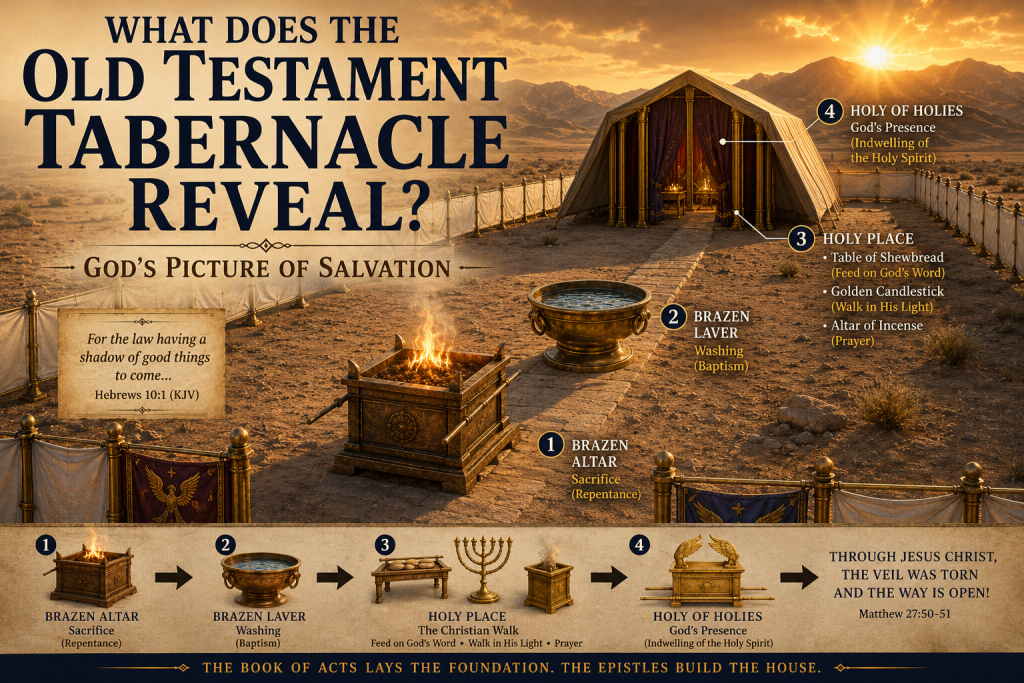
From the Brazen Altar to the Holy of Holies, every step pointed to Jesus Christ.
Many people ask, “Was baptism in the Old Testament?”
The answer begins with understanding the Tabernacle.
Long before John the Baptist came preaching in the wilderness… long before the Day of Pentecost… and long before the Apostle Peter proclaimed Acts 2:38, God had already given Israel a beautiful picture of His plan of redemption through the Tabernacle and its furnishings.
While Christian baptism was fully revealed after the death, burial, and resurrection of Jesus Christ, the principles behind God’s plan of salvation had already been illustrated centuries earlier.
God painted the picture long before He revealed its fulfillment.
The writer of Hebrews tells us that the priests served “unto the example and shadow of heavenly things” (Hebrews 8:5). Later he writes,
“For the law having a shadow of good things to come…”
Hebrews 10:1 (KJV)
The Tabernacle was much more than a place of worship.
It was God’s picture book of redemption.
As we walk through the Tabernacle, we’ll discover how each piece of furniture beautifully points us to Jesus Christ and the New Testament plan of salvation.
The Brazen Altar — A Picture of Repentance
The first object every priest encountered was the Brazen Altar.
Everything began with sacrifice.
An innocent animal died in the place of the guilty.
Without the shedding of blood there could be no approach unto God.
This altar beautifully points us to repentance.
Before there is baptism…
Before there is the infilling of the Holy Ghost…
There must first be repentance.
Repentance is more than feeling sorrow for sin.
It is dying to the old life.
Paul wrote,
“Knowing this, that our old man is crucified with him…”
Romans 6:6 (KJV)
Just as the sacrifice came first in the Tabernacle, repentance comes first in God’s New Testament plan of salvation.
The Brazen Laver — A Picture of Baptism
After the sacrifice came the Brazen Laver.
God instructed Moses,
Aaron and his sons shall wash their hands and their feet thereat:
When they go into the tabernacle of the congregation, they shall wash with water, that they die not…”**
Exodus 30:19-20 (KJV)
The priest could not ignore the laver.
Before entering farther into God’s presence, he had to be washed.
This beautifully points forward to New Testament baptism.
When Ananias spoke to Saul, he said,
“And now why tarriest thou? arise, and be baptized, and wash away thy sins, calling on the name of the Lord.”
Acts 22:16 (KJV)
The Brazen Laver was not Christian baptism itself.
Rather, it was one of the Old Testament shadows pointing forward to the cleansing God would accomplish through Jesus Christ.
The Holy Place — The Christian Walk
After passing the laver, the priest entered the Holy Place.
Here the picture changes.
The sacrifice was behind him.
The washing was behind him.
Now began his daily ministry before the Lord.
While Scripture does not specifically identify the Holy Place as representing the Epistles, I believe it beautifully illustrates the Christian life that the Epistles teach after the foundation has been laid.
Inside the Holy Place stood three beautiful pieces of furniture.
The Table of Shewbread
The priests continually ate the holy bread.
Jesus said,
“Man shall not live by bread alone, but by every word that proceedeth out of the mouth of God.”
Matthew 4:4 (KJV)
After the foundation has been laid, believers continue growing by feeding upon God’s Word.
The Epistles teach us how to grow in grace, wisdom, faith, and obedience.
The Golden Candlestick
The Holy Place had no windows.
Its only light came from the seven-branched golden candlestick.
Likewise, believers today walk by the light of God’s Word and the leading of His Spirit.
The Epistles continually teach us to walk in holiness…
Walk in love…
Walk by faith…
Walk worthy of our calling…
As His light shines upon our path.
The Altar of Incense
The priest continually offered incense before the Lord.
Throughout Scripture, incense becomes a beautiful picture of prayer.
John wrote,
“…golden vials full of odours, which are the prayers of saints.”
Revelation 5:8 (KJV)
Again he wrote,
“And the smoke of the incense…ascended up before God with the prayers of the saints.”
Revelation 8:3-4 (KJV)
Just as the incense continually ascended before God, believers today are encouraged to pray continually.
The Epistles remind us:
“Pray without ceasing.”
“Continue in prayer.”
“Praying always.”
Prayer remains one of the greatest privileges of every child of God.
The Veil Was Torn
Beyond the Holy Place stood a thick veil.
Behind that veil was the Holy of Holies.
Only the High Priest could enter, and only once each year, and never without blood.
The veil constantly reminded Israel that sinful man could not freely enter God’s holy presence.
But everything changed at Calvary.
Matthew records,
Jesus, when he had cried again with a loud voice, yielded up the ghost.
And, behold, the veil of the temple was rent in twain from the top to the bottom…”**
Matthew 27:50-51 (KJV)
Notice something beautiful.
The veil was torn from the top to the bottom.
Man did not reach God.
God opened the way for man.
The Old Testament shadows had fulfilled their purpose.
Jesus Christ had become the perfect sacrifice.
The way into God’s presence had been opened.
The Holy of Holies — God’s Presence
Beyond the veil was the Holy of Holies.
This was the dwelling place of God’s presence above the Mercy Seat.
Only the High Priest could enter, and only once each year.
Under the New Covenant something wonderful happened.
God no longer dwells in temples made with hands.
Instead, He fills His people with His Spirit.
Paul wrote,
“Know ye not that ye are the temple of God, and that the Spirit of God dwelleth in you?”
1 Corinthians 3:16 (KJV)
What was once pictured in the Tabernacle now finds its fulfillment through Jesus Christ as God dwells within His people.
The Book of Acts Lays the Foundation
For many years I have often said,
“The Book of Acts lays the foundation. The Epistles build the house.”
The Tabernacle beautifully illustrates that pattern.
The Brazen Altar reminds us of repentance.
The Brazen Laver points us toward baptism.
The torn veil reminds us that Jesus Christ has opened the way.
The Holy of Holies reminds us of God’s Spirit dwelling within His people.
Then the Holy Place beautifully illustrates the Christian life that the Epistles teach after that foundation has been laid.
We feed upon God’s Word.
We walk in His light.
We continually lift our prayers before Him.
We grow in grace.
We become more like Jesus Christ every day.
Conclusion
The Tabernacle was God’s picture book.
Every piece of furniture pointed forward to Jesus Christ.
The Brazen Altar pointed to sacrifice.
The Brazen Laver pointed to cleansing.
The Holy Place illustrates a life of worship, prayer, and spiritual growth.
The torn veil declared that the way into God’s presence had been opened.
The Holy of Holies reminds us that under the New Covenant, God now dwells within His people by His Spirit.
The Old Testament contains the shadows.
The New Testament reveals the fulfillment.
For the law was given by Moses, but grace and truth came by Jesus Christ. John 1:17 (KJV)
Not because the Law was bad—but because the Law pointed forward.
The Tabernacle was God’s inspired picture, and in Jesus Christ, that picture comes into full view.
As we study both together, we see the beautiful harmony of God’s Word from Genesis to Revelation.
May we never stop searching the Scriptures, for they testify of Jesus Christ.