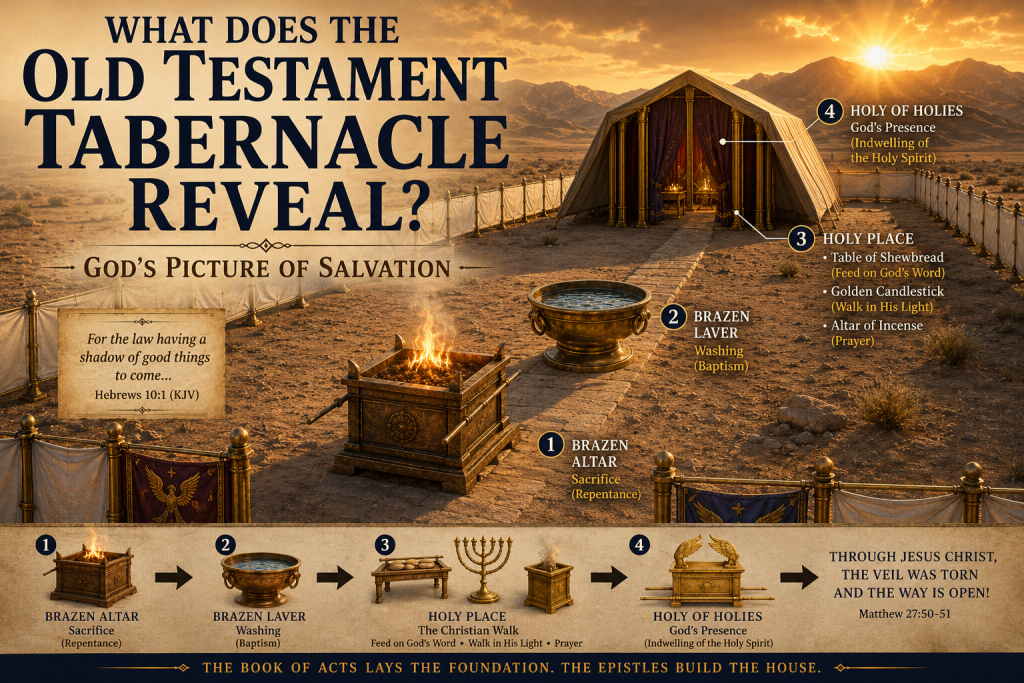
From the Brazen Altar to the Holy of Holies, every step pointed to Jesus Christ.
Many people ask, “Was baptism in the Old Testament?”
The answer begins with understanding the Tabernacle.
Long before John the Baptist came preaching in the wilderness… long before the Day of Pentecost… and long before the Apostle Peter proclaimed Acts 2:38, God had already given Israel a beautiful picture of His plan of redemption through the Tabernacle and its furnishings.
While Christian baptism was fully revealed after the death, burial, and resurrection of Jesus Christ, the principles behind God’s plan of salvation had already been illustrated centuries earlier.
God painted the picture long before He revealed its fulfillment.
The writer of Hebrews tells us that the priests served “unto the example and shadow of heavenly things” (Hebrews 8:5). Later he writes,
“For the law having a shadow of good things to come…”
Hebrews 10:1 (KJV)
The Tabernacle was much more than a place of worship.
It was God’s picture book of redemption.
As we walk through the Tabernacle, we’ll discover how each piece of furniture beautifully points us to Jesus Christ and the New Testament plan of salvation.
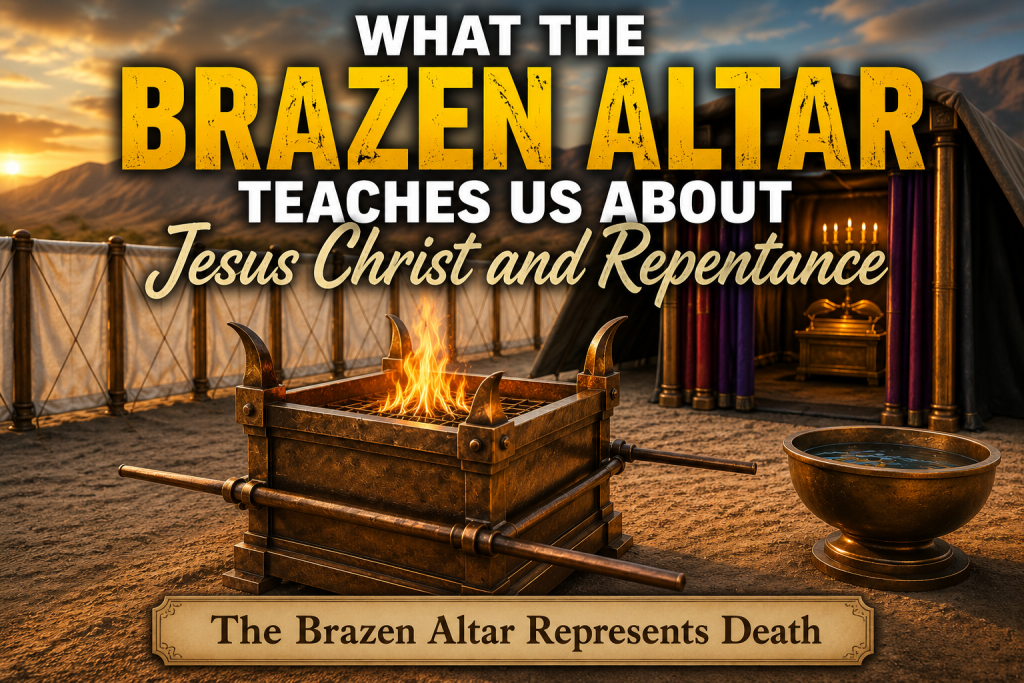
The Brazen Altar — A Picture of Repentance
The first object every priest encountered was the Brazen Altar.
Everything began with sacrifice.
An innocent animal died in the place of the guilty.
Without the shedding of blood there could be no approach unto God.
This altar beautifully points us to repentance.
Before there is baptism…
Before there is the infilling of the Holy Ghost…
There must first be repentance.
Repentance is more than feeling sorrow for sin.
It is dying to the old life.
Paul wrote,
“Knowing this, that our old man is crucified with him…”
Romans 6:6 (KJV)
Just as the sacrifice came first in the Tabernacle, repentance comes first in God’s New Testament plan of salvation.
The Brazen Laver — A Picture of Baptism
After the sacrifice came the Brazen Laver.
God instructed Moses,
Aaron and his sons shall wash their hands and their feet thereat:
When they go into the tabernacle of the congregation, they shall wash with water, that they die not…”**
Exodus 30:19-20 (KJV)
The priest could not ignore the laver.
Before entering farther into God’s presence, he had to be washed.
This beautifully points forward to New Testament baptism.
When Ananias spoke to Saul, he said,
“And now why tarriest thou? arise, and be baptized, and wash away thy sins, calling on the name of the Lord.”
Acts 22:16 (KJV)
The Brazen Laver was not Christian baptism itself.
Rather, it was one of the Old Testament shadows pointing forward to the cleansing God would accomplish through Jesus Christ.
The Holy Place — The Christian Walk
After passing the laver, the priest entered the Holy Place.
Here the picture changes.
The sacrifice was behind him.
The washing was behind him.
Now began his daily ministry before the Lord.
While Scripture does not specifically identify the Holy Place as representing the Epistles, I believe it beautifully illustrates the Christian life that the Epistles teach after the foundation has been laid.
Inside the Holy Place stood three beautiful pieces of furniture.
The Table of Shewbread
The priests continually ate the holy bread.
Jesus said,
“Man shall not live by bread alone, but by every word that proceedeth out of the mouth of God.”
Matthew 4:4 (KJV)
After the foundation has been laid, believers continue growing by feeding upon God’s Word.
The Epistles teach us how to grow in grace, wisdom, faith, and obedience.
The Golden Candlestick
The Holy Place had no windows.
Its only light came from the seven-branched golden candlestick.
Likewise, believers today walk by the light of God’s Word and the leading of His Spirit.
The Epistles continually teach us to walk in holiness…
Walk in love…
Walk by faith…
Walk worthy of our calling…
As His light shines upon our path.
The Altar of Incense
The priest continually offered incense before the Lord.
Throughout Scripture, incense becomes a beautiful picture of prayer.
John wrote,
“…golden vials full of odours, which are the prayers of saints.”
Revelation 5:8 (KJV)
Again he wrote,
“And the smoke of the incense…ascended up before God with the prayers of the saints.”
Revelation 8:3-4 (KJV)
Just as the incense continually ascended before God, believers today are encouraged to pray continually.
The Epistles remind us:
“Pray without ceasing.”
“Continue in prayer.”
“Praying always.”
Prayer remains one of the greatest privileges of every child of God.
The Veil Was Torn
Beyond the Holy Place stood a thick veil.
Behind that veil was the Holy of Holies.
Only the High Priest could enter, and only once each year, and never without blood.
The veil constantly reminded Israel that sinful man could not freely enter God’s holy presence.
But everything changed at Calvary.
Matthew records,
Jesus, when he had cried again with a loud voice, yielded up the ghost.
And, behold, the veil of the temple was rent in twain from the top to the bottom…”**
Matthew 27:50-51 (KJV)
Notice something beautiful.
The veil was torn from the top to the bottom.
Man did not reach God.
God opened the way for man.
The Old Testament shadows had fulfilled their purpose.
Jesus Christ had become the perfect sacrifice.
The way into God’s presence had been opened.
The Holy of Holies — God’s Presence
Beyond the veil was the Holy of Holies.
This was the dwelling place of God’s presence above the Mercy Seat.
Only the High Priest could enter, and only once each year.
Under the New Covenant something wonderful happened.
God no longer dwells in temples made with hands.
Instead, He fills His people with His Spirit.
Paul wrote,
“Know ye not that ye are the temple of God, and that the Spirit of God dwelleth in you?”
1 Corinthians 3:16 (KJV)
What was once pictured in the Tabernacle now finds its fulfillment through Jesus Christ as God dwells within His people.
The Book of Acts Lays the Foundation
For many years I have often said,
“The Book of Acts lays the foundation. The Epistles build the house.”
The Tabernacle beautifully illustrates that pattern.
The Brazen Altar reminds us of repentance.
The Brazen Laver points us toward baptism.
The torn veil reminds us that Jesus Christ has opened the way.
The Holy of Holies reminds us of God’s Spirit dwelling within His people.
Then the Holy Place beautifully illustrates the Christian life that the Epistles teach after that foundation has been laid.
We feed upon God’s Word.
We walk in His light.
We continually lift our prayers before Him.
We grow in grace.
We become more like Jesus Christ every day.
Conclusion
The Tabernacle was God’s picture book.
Every piece of furniture pointed forward to Jesus Christ.
The Brazen Altar pointed to sacrifice.
The Brazen Laver pointed to cleansing.
The Holy Place illustrates a life of worship, prayer, and spiritual growth.
The torn veil declared that the way into God’s presence had been opened.
The Holy of Holies reminds us that under the New Covenant, God now dwells within His people by His Spirit.
The Old Testament contains the shadows.
The New Testament reveals the fulfillment.
For the law was given by Moses, but grace and truth came by Jesus Christ.John 1:17 (KJV)
Not because the Law was bad—but because the Law pointed forward.
The Tabernacle was God’s inspired picture, and in Jesus Christ, that picture comes into full view.
As we study both together, we see the beautiful harmony of God’s Word from Genesis to Revelation.
May we never stop searching the Scriptures, for they testify of Jesus Christ.
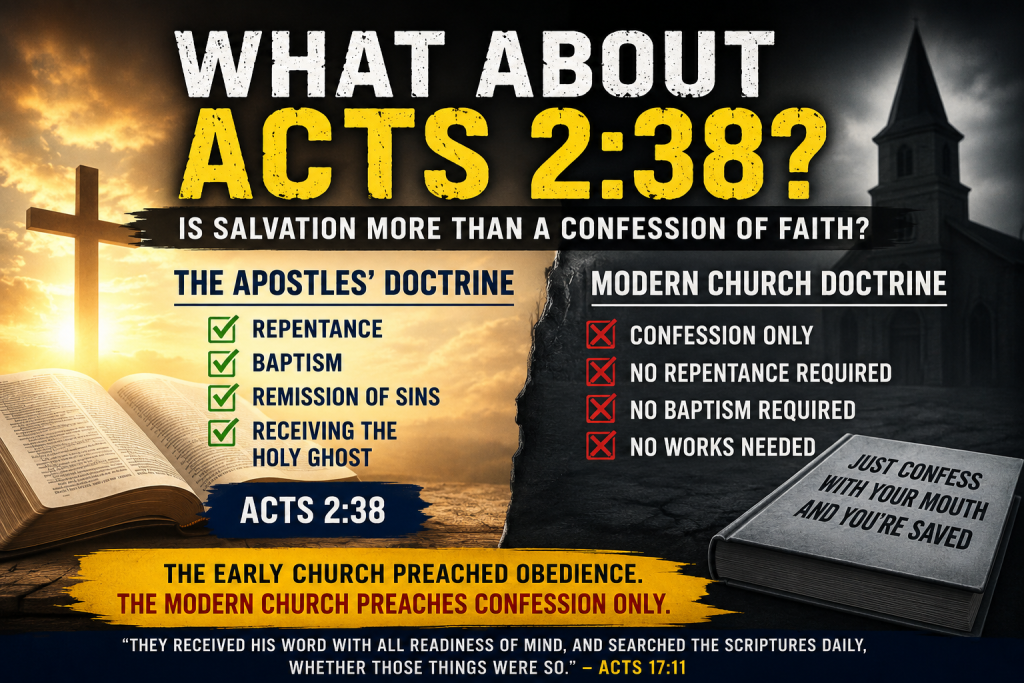
Modern Christianity often presents salvation as little more than a moment of verbal confession—simply believing in Jesus and declaring Him as Lord. Romans 10:9–10 is frequently isolated from its setting and used as a complete formula for salvation in the modern church world today, while the foundation established in the Book of Acts is often overlooked entirely. As a result, faith is commonly reduced to intellectual agreement rather than a life-changing response to the Gospel.
This raises an important question:
If confession alone is the complete plan of salvation, why did the apostles in Acts consistently preach repentance, baptism in the name of Jesus Christ, and the receiving of the Holy Ghost?
The contrast between modern doctrine and the apostolic message becomes especially clear on the Day of Pentecost. After Peter preached the death, burial, and resurrection of Jesus Christ, the people were “pricked in their heart” and asked the apostles and brethren:
“Men and brethren, what shall we do?” — Acts 2:37 (KJV)
Peter did not answer by telling them to simply confess faith alone.
What Did Peter Actually Preach?
Instead, he gave a direct response:
“Repent, and be baptized every one of you in the name of Jesus Christ for the remission of sins, and ye shall receive the gift of the Holy Ghost.” — Acts 2:38 (KJV)
This was not presented as optional discipleship, nor as a secondary step after salvation. It was the apostles’ response to men seeking salvation under the New Covenant.
Yet much of the modern church world now teaches something far different. Salvation is often presented as a one-time confession apart from repentance, apart from baptism, and apart from the transforming power of the Holy Spirit. Faith becomes merely acknowledging facts about Jesus rather than obeying the Gospel.
Biblical Faith Always Responds
But throughout Scripture, biblical faith was never passive agreement alone.
Faith moved Noah to build. Faith moved Abraham to leave his familar surroundings. Faith moved Israel to step into the sea. Faith moved sinners in Acts to repent, be baptized in Jesus name, and receive the Holy Ghost.
The apostles never separated faith from obedience because true faith always responds to God.
Paul himself spoke of:
“the obedience of faith” — Romans 1:5 (KJV)
and again:
“they have not all obeyed the gospel.” — Romans 10:16 (KJV)
Even within Romans, the very book often used to defend salvation by confession alone, Paul continually connects faith with obedience, transformation, holiness, and walking in newness of life.
Romans and Acts Must Remain Together
The modern doctrine that reduces salvation to a verbal confession creates a serious contradiction with the pattern established throughout the Book of Acts. The early church did not preach faith apart from repentance, nor belief apart from obedience. They preached a Gospel that called men and women to surrender their lives fully unto Jesus Christ.
The issue is not whether salvation comes by grace through faith. Scripture clearly teaches that it does. The real question is this:
What did the apostles understand saving faith to be?
Modern religion often defines faith as a verbal agreement alone. But the apostles taught a faith that responded, obeyed, repented, was baptized, and received the promised gift of the Holy Ghost.
When Romans is separated from Acts, confusion follows. But when the Epistles are read in harmony with the foundation laid by the apostles, the message remains consistent from beginning to end:
Jesus Christ not only calls men to believe the Gospel— He calls them to obey it.
Which church is right? What Bible translation is best? Why is the world changing? What do the prophecies mean?
But there is one question most people avoid asking altogether:
“Will I actually be saved?”
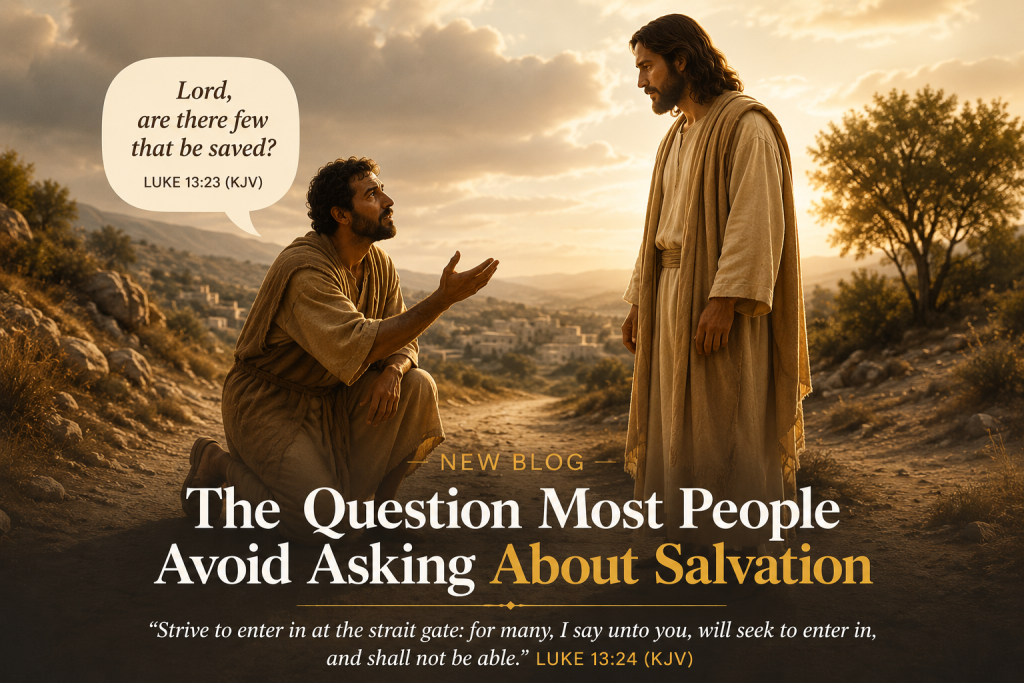
In Luke 13:23, a man asked Jesus a question that still echoes through every generation:
“Lord, are there few that be saved?”
Jesus did not avoid the question. He did not soften the answer. And what He said next may be one of the most sobering warnings in all of Scripture.
“And he said unto them, Strive to enter in at the strait gate: for many, I say unto you, will seek to enter in, and shall not be able.” — Luke 13:24 (KJV)
Jesus did not say: “Do not worry about it.” He did not say: “Everyone will make it.” And He did not say salvation would come casually or effortlessly.
Instead, He said: “Strive to enter in at the strait gate.”
The word “strive” carries the idea of effort, urgency, discipline, and determination. It paints the picture of someone pressing forward with purpose, refusing to quit, and understanding the seriousness of what is at stake.
This is not speaking of earning salvation through human works, but rather revealing the seriousness of pursuing the Kingdom of God with sincerity, obedience, faith, and perseverance.
The gate is called “strait” because it is narrow. It is not the broad path of popular opinion, worldly compromise, or comfortable religion.
Jesus gave a similar warning in Matthew 7:13-14:
“Enter ye in at the strait gate: for wide is the gate, and broad is the way, that leadeth to destruction, and many there be which go in thereat: Because strait is the gate, and narrow is the way, which leadeth unto life, and few there be that find it.”
Perhaps the most sobering part of Luke 13:24 is this:
“Many… will seek to enter in, and shall not be able.”
Many will seek. But not all will strive.
Many will desire heaven, yet refuse surrender. Many will want eternal life, yet reject obedience to the Word of God.
The man in Luke 13 asked the most important question a person could ever ask: “Who will actually be saved?”
And Jesus answered with a warning that still speaks to every generation today.
Luke 16:16 gives more detail — The law and the prophets were until John: since that time the kingdom of God is preached, and every man presseth into it.
Salvation is not something to approach casually. It is worth seeking with all of our heart, all of our faith, and all of our obedience while there is still time.
God, in His manifold wisdom, made the beginning of the salvation journey simple and clear. He placed the foundation of the New Birth experience within a single verse of Scripture in the Whole New Testament.
“Then Peter said unto them, Repent, and be baptized every one of you in the name of Jesus Christ for the remission of sins, and ye shall receive the gift of the Holy Ghost.”
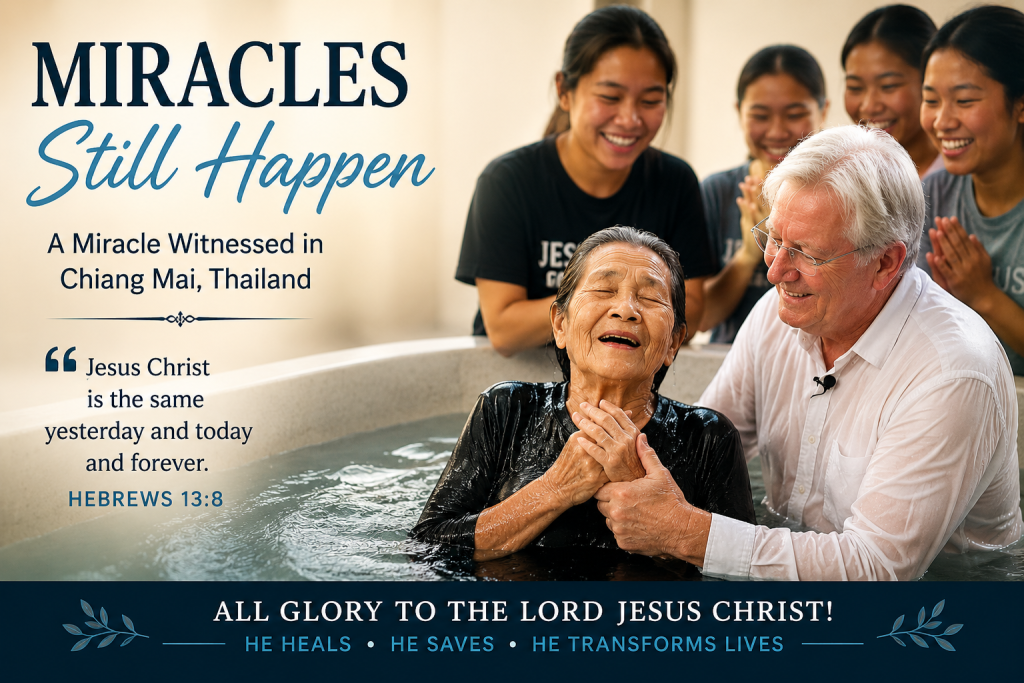
This happened during our Missionary work in Thailand 2018-2024. In early 2020, a young lady from our church in Chiang Mai, Thailand, contacted my wife and explained that she and several friends planned to travel to Chiang Rai to bring her mother back to Chiang Mai for baptism in the Name of Jesus Christ.
My wife gladly agreed.
That Saturday afternoon, after a four-hour drive, they called to let us know they were about an hour away. We had already prepared the baptismal water and were praying in anticipation of their arrival.
At that point, we knew nothing about her mother’s condition.
When they arrived, we walked outside to greet them. As the back passenger door opened, three young people carefully helped this precious Thai mother into a wheelchair.
It was immediately clear that she could not walk.
As we entered the baptism room, I realized her condition was even worse than I first thought. Not only could she not walk—she could not speak. The only sounds she could make were grunts.
She was visibly terrified.
Her eyes reflected fear and confusion as she looked around the room. At that moment, I knew she did not need questions—she needed peace.
I stepped into the baptismal waters beside her and began to pray, asking the Lord Jesus Christ to calm her fears and touch her life.
As we prayed, peace slowly came over her.
Holding her gently in my arms, I said, “Mom, I now baptize you in the Name of Jesus Christ.”
Then something happened that none of us will ever forget.
As she came up out of the water, she suddenly stood upright on her own. She stepped out of the baptismal tank and began walking around the room saying, “I’m hungry! I’m hungry!”
Tears filled the room as we witnessed the miracle the Lord Jesus had performed for this precious mother.
Until that day, she had only known Buddhism, as is the case for most Thai people. Yet on that day, Jesus entered the room, saw the faith of these young believers, and responded with a miracle that astonished everyone present.
Later, her daughter explained that her mother had spent years in a mental institution before eventually becoming bedridden for many more years at home.
We had known none of this beforehand.
But the Lord Jesus knew.
Over the years, I have witnessed many miracles and healings, but I can honestly say this was unlike anything I had ever seen before.
Glory to the Lord Jesus Christ.
Continue Reading
This testimony is an excerpt from Chapter 2 of my book, Faith Unto Salvation, where I share personal experiences, biblical teachings, and the transforming power of the Lord Jesus Christ.
If you would like to learn more, you can explore the book here:
Many people talk about being ‘born again’… but few stop to ask what Jesus actually meant.
Some think it’s just a feeling. Others believe it’s simply a confession.
But when Jesus spoke about being born again… He spoke clearly — and He meant something specific.
Let’s go straight to the Scripture.
The Scripture
“Jesus answered, Verily, verily, I say unto thee, Except a man be born of water and of the Spirit, he cannot enter into the kingdom of God.” — John 3:5
These are not casual words.
Jesus said: 👉 “Except a man…”
That means this is not optional.
What Does It Mean to Be Born of Water?
Being born of water is not a mystery when we compare Scripture with Scripture.
In Acts 2:38, Peter said:
👉 “Repent, and be baptized every one of you in the name of Jesus Christ for the remission of sins…”
Baptism in water is directly connected to the remission of sins.
It is not just a symbol — it is obedience to what was preached.
When a person is baptized in the name of Jesus Christ, they are identifying with His death, burial, and resurrection.
You can also see this in Romans 6:3
What Does It Mean to Be Born of the Spirit?
Jesus said we must also be born “of the Spirit.”
This is the promise of the Holy Ghost.
In Acts 2:38, Peter continued:
👉 “…and ye shall receive the gift of the Holy Ghost.”
This is not reserved for a select few.
It is a promise.
The Spirit of God dwelling within a person brings transformation — not just outward, but inward.
This is also referenced by Apostle Paul to the Church at Rome — in Romans 6:4
How John 3:5 and Acts 2:38 Work Together
When we look at John 3:5 and Acts 2:38 together, the picture becomes clear:
Born of water → Baptism in the name of Jesus Christ
Born of the Spirit → Receiving the gift of the Holy Ghost
Scripture does not contradict itself — it confirms itself.
Many people quote Acts 2:38… but few truly understand what it means.
Some treat it as a suggestion. Others avoid it altogether.
But when we slow down and let Scripture speak for itself, we begin to see something powerful — something clear, direct, and life-changing.
In this article, we are going to walk through Acts 2:38 step by step… not with opinions, but with the Word of God.
The Scripture
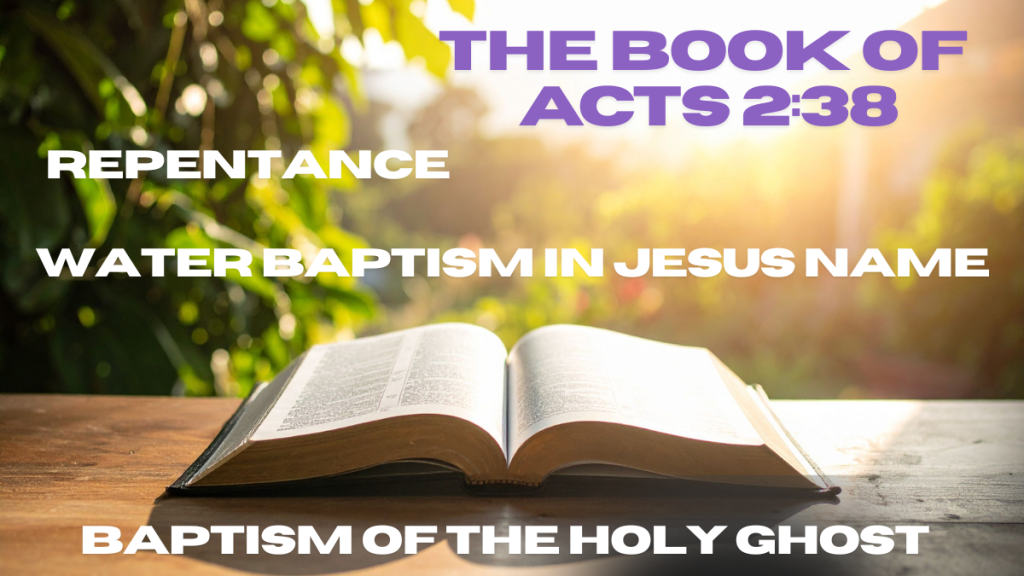
“Then Peter said unto them, Repent, and be baptized every one of you in the name of Jesus Christ for the remission of sins, and ye shall receive the gift of the Holy Ghost.” — Acts 2:38
This was not spoken casually. This was the response given when people asked:
👉 “What shall we do?”
Peter did not hesitate. He gave them a clear answer.
What Does “Repent” Mean in Acts 2:38?
Repentance is more than saying “I’m sorry.”
It is a turning.
A turning away from sin… and a turning toward God.
It is when a person begins to see their life through the lens of God’s Word — and realizes something needs to change.
Repentance is where it begins.
Without repentance, nothing else in Acts 2:38 can truly take root.
Why Baptism in the Name of Jesus Christ Matters
Peter did not say to be baptized in titles.
He said:
👉 “in the name of Jesus Christ”
This matters.
Because baptism is not just a symbol — it is connected to the remission of sins.
When we are baptized in the name of Jesus Christ, we are identifying with Him — His death, His burial, and His resurrection.
It is not tradition. It is obedience to what was preached.
What Does It Mean to Receive the Holy Ghost?
The final part of Acts 2:38 is a promise:
👉 “ye shall receive the gift of the Holy Ghost”
This is not something reserved for a select few.
It is a gift.
The Holy Ghost is the Spirit of God dwelling within a person — empowering them to live a new life.
This is not just a moment… it is a transformation.
The Power of Acts 2:38
Acts 2:38 is not complicated.
But it is powerful.
It answers the question:
👉 What must I do?
Repent
Be baptized in the name of Jesus Christ
Receive the gift of the Holy Ghost
This is not man’s idea.
This is Scripture.
A Final Thought
Many people want the benefits of faith… without the response that Scripture calls for.
But Acts 2:38 shows us something different.
It shows us that faith responds.
It turns. It obeys. It receives.
Go Deeper
If you want to go deeper into this subject and others rooted in Scripture:
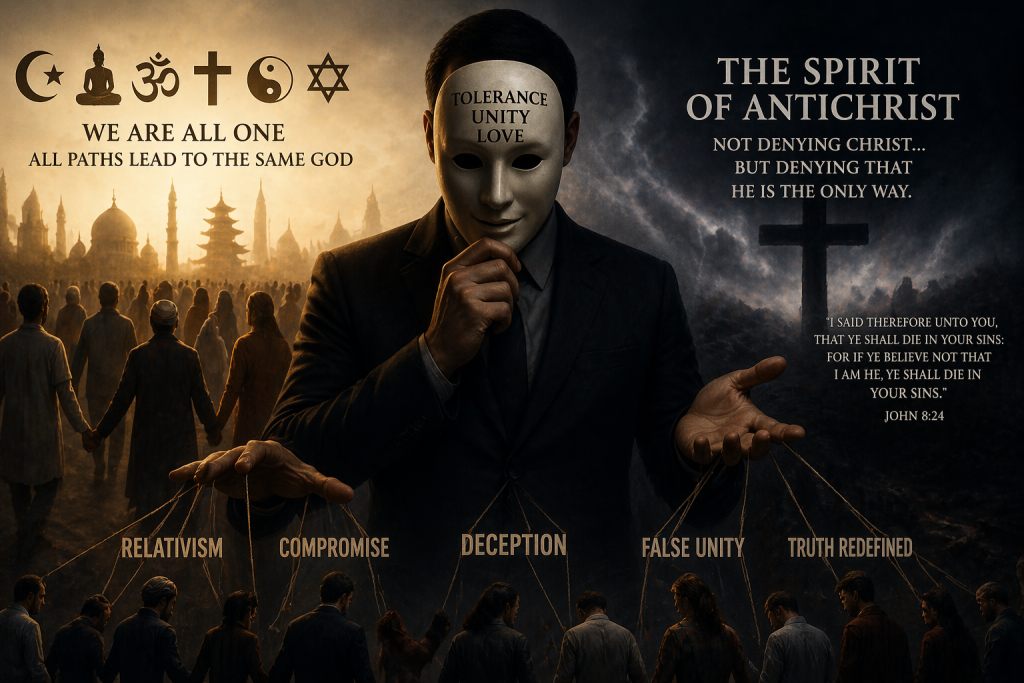
People have heard much about the Antichrist. Yet very few understand or even heard about the spirit of antichrist—what it looks like, how it speaks, and how easily it blends into everyday conversation.
It does not always come with open rebellion. More often, it comes wrapped in words that sound peaceful, reasonable, and even compassionate.
I was reminded of this not long after arriving in Thailand.
Mr. Richardson, a Thai friend, came to visit our home. During our conversation, I shared with him my desire to find a building—to establish a church.
He smiled and asked, “You want to have a church building here?”
I said, “Sure.” I explained that my purpose in coming to Thailand was simple: the Thai people need to know who the True and Living God is—Jesus Christ is His Name.
Mr. Richardson paused, then responded with a tone of gentle skepticism:
“Ah… what’s the big deal? Everyone’s god is the same. He is just called by different names.”
Now, on the surface, that sounds harmless. Even kind. It sounds like unity.
So I answered him plainly:
“So you’re telling me we should all just hold hands, sing ‘Kumbaya,’ be one big happy family—and come together to worship your god, whether his name is Buddha, Allah, Brahma, Vishnu, Shiva, or Hare Krishna?”
What he said reflects a mindset that is becoming more common in our day.
A mindset that says:
Truth is flexible
Beliefs are interchangeable
And ultimately… all paths lead to the same place
But the Word of God does not agree with that.
The Lord Jesus Christ Himself said:
“If ye believe not that I am he, ye shall die in your sins.” — John 8:24
That is not a statement of inclusion. That is a line drawn in truth.
What Mr. Richardson expressed may sound appealing— gentle, comforting, and non-confrontational.
But Scripture identifies this very thinking as something far more serious.
It is the spirit of antichrist.
Not because it openly opposes religion… but because it quietly replaces truth with compromise.
The spirit of antichrist does not always deny God outright. Instead, it redefines Him.
It says:
“Jesus is one of many ways”
“All beliefs are valid”
“Let’s not divide over doctrine”
And in doing so, it removes the very foundation of the Gospel.
We are living in a time where the pressure to “go along to get along” is increasing.
Stand firm, and you will be called narrow. Speak truth, and you will be labeled intolerant. Refuse compromise, and you will be misunderstood.
But truth has never been determined by majority opinion.
The danger is not always in what sounds wrong.
The danger is in what sounds almost right.
Why This Matters
Because deception in the last days will not always be obvious.
It will feel reasonable. It will sound loving. It will appear unified.
But if it denies who Jesus truly is—it is not from God.
A Question to Consider
Are we shaping truth to fit the world… or are we allowing the Word of God to shape us?
Closing Thought
Unity without truth is not unity—it is compromise.
And the spirit of antichrist thrives wherever truth is quietly set aside for the sake of getting along.
Acts 2:38 is one of the clearest statements in the Bible about salvation. In this verse, the apostle Peter instructs those who were convicted in their hearts to repent, be baptized in the name of Jesus Christ for the remission of sins, and receive the gift of the Holy Spirit. This shows that salvation is not just a confession of faith, but a response that involves repentance, obedience, and spiritual transformation.
In the previous post, Faith and Repentance: Vital Ingredients in Our Spiritual Foundation, we began to see what forms the foundation of salvation.
In this post, we take the next step and look at what that foundation actually looks like according to Scripture.
Body
On the Day of Pentecost, recorded in the Book of Acts, the people who heard Peter preach were deeply moved. They asked a direct question:
“Men and brethren, what shall we do?”
Peter’s answer was just as direct:
“Repent, and be baptized every one of you in the name of Jesus Christ for the remission of sins, and ye shall receive the gift of the Holy Ghost.” (Acts 2:38)
This response reveals three essential elements:
1. Repentance
Repentance is more than saying “I’m sorry.” It is a turning of the heart—a decision to turn away from sin and turn toward God.
2. Baptism in the Name of Jesus Christ
Peter specifically instructed them to be baptized in the name of Jesus Christ. This was not presented as optional, but as part of the response to the Gospel. Baptism represents the washing away of sins and identification with Christ.
3. Receiving the Holy Spirit
The promise did not stop with repentance and baptism. Peter said they would receive the gift of the Holy Spirit. This is the inward work of God that brings new life.
What This Means for Salvation
Acts 2:38 shows that salvation is not simply a moment of verbal confession—it is a response to the Gospel that involves both obedience and transformation.
This ties directly into a deeper question many people ask:
Is salvation just a confession, or is it a transformation?
(You can explore that more fully here: Is Salvation Just a Confession — or a Transformation?)
Conclusion
When we read Acts 2:38 in its context, we see a clear and powerful message:
Salvation is not passive—it is a response.
It begins with Faith, and because we have faith, repentance will come, then we will be obedient to wash away our sins through water baptism in the name of Jesus Christ. Then a transformed life through the power of the Holy Ghost will give us the power to be what the Lord desires for us..
“But without faith it is impossible to please him: for he that cometh to God must believe that he is, and that he is a rewarder of them that diligently seek him.” — Hebrews 11:6
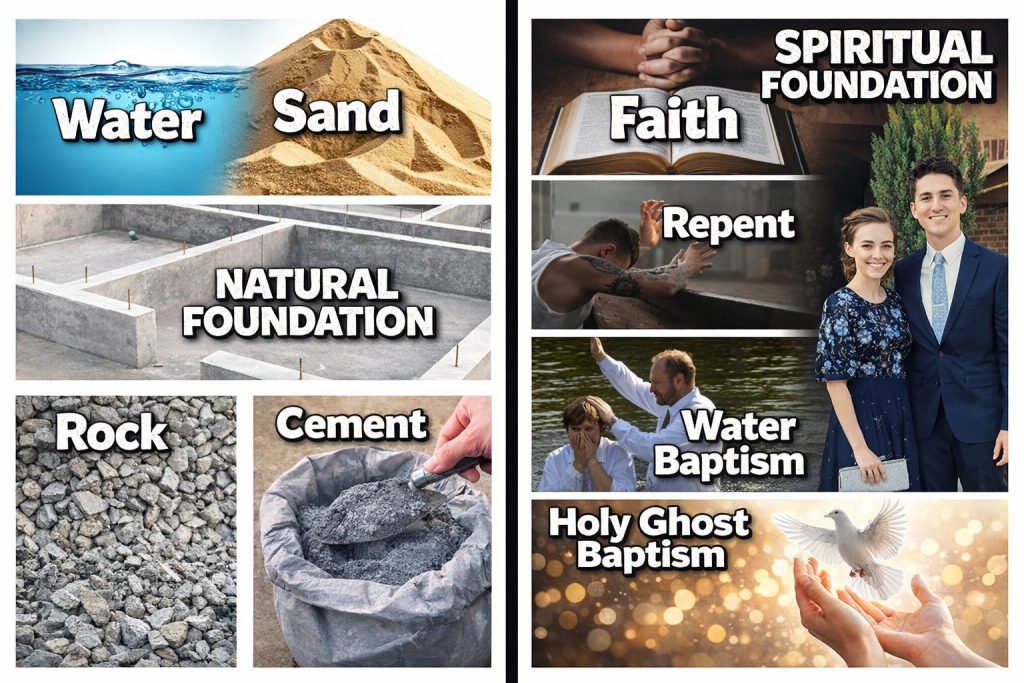
There are vital ingredients to our spiritual foundation, just as there are essential elements in a natural foundation.
In the natural, a strong foundation is made using water, sand, rock, and cement—often reinforced with steel rebar for strength and stability. If any of these ingredients are left out, the foundation is incomplete.
In the same way, our spiritual foundation is made up of four vital ingredients:
Faith, Repentance, Water Baptism in the name of Jesus Christ, and the Baptism of the Holy Ghost.
This is our spiritual foundation. If any of these are left out, our spiritual foundation is incomplete.
Before any structure can stand, the foundation must first be laid.
If the foundation is not right, everything built upon it will be unstable.
We begin with faith.
“But without faith it is impossible to please him…” — Hebrews 11:6
Faith is what brings a man to God.
It is the realization that God is real, that His Word is true, and that He is a rewarder of those who diligently seek Him.
But faith is not just an acknowledgement.
When a man truly believes… for believe is an action word, not just said.
something happens within him.
There is a stirring. A conviction. A realization that he cannot remain the same.
This is where repentance begins.
“Repent, and be baptized every one of you in the name of Jesus Christ for the remission of sins…” — Acts 2:38
Repentance is more than saying, “I’m sorry.”
It is a turning of the heart, a change of mind, and a decision to leave one path and begin walking in another.
A man does not repent to find faith…
He repents because he believes.
Faith brings a man to God, but repentance is where he begins to turn.
Without repentance, there is no true change.
A person may believe… they may feel conviction…
But until there is a turning, the foundation is incomplete.
Just as a man cannot build a house without first preparing the ground…
Faith and repentance is the beginning of our spiritual foundation.
So the question is not simply:
Do I believe?
But rather:
Has there been a turning in my life?
Have I begun laying the foundation… or am I trying to build without it?
Because faith and repentance are not separate ideas…
They are vital ingredients in our spiritual foundation.