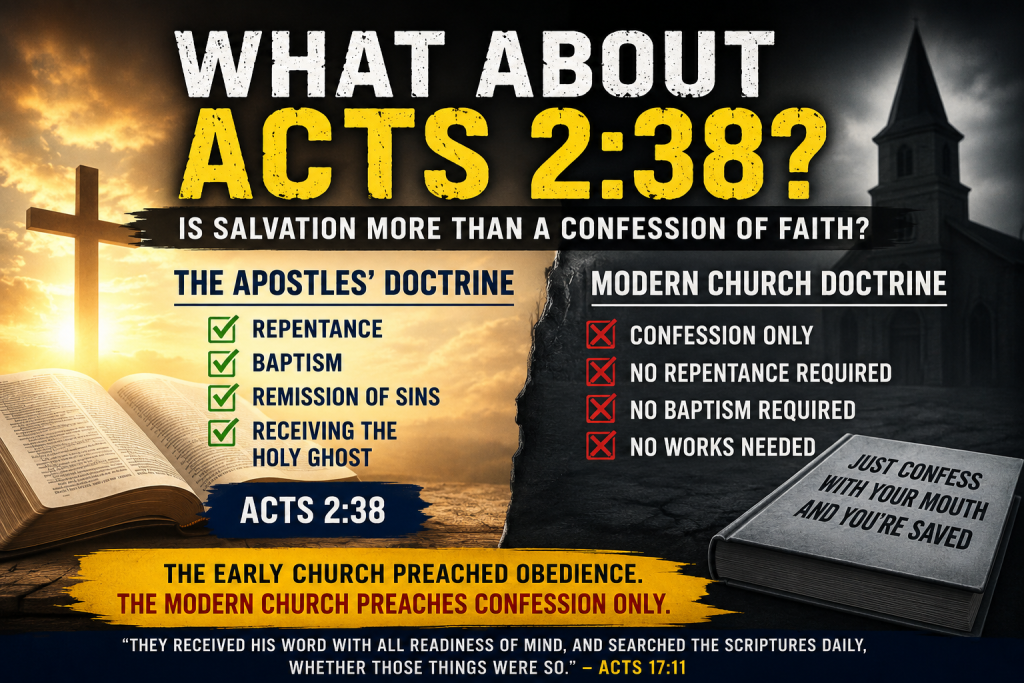
Modern Christianity often presents salvation as little more than a moment of verbal confession—simply believing in Jesus and declaring Him as Lord. Romans 10:9–10 is frequently isolated from its setting and used as a complete formula for salvation in the modern church world today, while the foundation established in the Book of Acts is often overlooked entirely. As a result, faith is commonly reduced to intellectual agreement rather than a life-changing response to the Gospel.
This raises an important question:
If confession alone is the complete plan of salvation, why did the apostles in Acts consistently preach repentance, baptism in the name of Jesus Christ, and the receiving of the Holy Ghost?
The contrast between modern doctrine and the apostolic message becomes especially clear on the Day of Pentecost. After Peter preached the death, burial, and resurrection of Jesus Christ, the people were “pricked in their heart” and asked the apostles and brethren:
“Men and brethren, what shall we do?”
— Acts 2:37 (KJV)
Peter did not answer by telling them to simply confess faith alone.
What Did Peter Actually Preach?
Instead, he gave a direct response:
“Repent, and be baptized every one of you in the name of Jesus Christ for the remission of sins, and ye shall receive the gift of the Holy Ghost.”
— Acts 2:38 (KJV)
This was not presented as optional discipleship, nor as a secondary step after salvation. It was the apostles’ response to men seeking salvation under the New Covenant.
Yet much of the modern church world now teaches something far different. Salvation is often presented as a one-time confession apart from repentance, apart from baptism, and apart from the transforming power of the Holy Spirit. Faith becomes merely acknowledging facts about Jesus rather than obeying the Gospel.
Biblical Faith Always Responds
But throughout Scripture, biblical faith was never passive agreement alone.
Faith moved Noah to build.
Faith moved Abraham to leave his familar surroundings.
Faith moved Israel to step into the sea.
Faith moved sinners in Acts to repent, be baptized in Jesus name, and receive the Holy Ghost.
The apostles never separated faith from obedience because true faith always responds to God.
Paul himself spoke of:
“the obedience of faith”
— Romans 1:5 (KJV)
and again:
“they have not all obeyed the gospel.”
— Romans 10:16 (KJV)
Even within Romans, the very book often used to defend salvation by confession alone, Paul continually connects faith with obedience, transformation, holiness, and walking in newness of life.
Romans and Acts Must Remain Together
The modern doctrine that reduces salvation to a verbal confession creates a serious contradiction with the pattern established throughout the Book of Acts. The early church did not preach faith apart from repentance, nor belief apart from obedience. They preached a Gospel that called men and women to surrender their lives fully unto Jesus Christ.
Acts 2:38 was not a contradiction to faith—it was the biblical response of faith.
The issue is not whether salvation comes by grace through faith. Scripture clearly teaches that it does. The real question is this:
What did the apostles understand saving faith to be?
Modern religion often defines faith as a verbal agreement alone. But the apostles taught a faith that responded, obeyed, repented, was baptized, and received the promised gift of the Holy Ghost.
When Romans is separated from Acts, confusion follows. But when the Epistles are read in harmony with the foundation laid by the apostles, the message remains consistent from beginning to end:
Jesus Christ not only calls men to believe the Gospel—
He calls them to obey it.
The Book Of Acts lays the Foundation
The Epistles Build the House.